
Monuments
Discover the historic side of Pardubice
When people think of Pardubice, gingerbread or horse racing often come to mind first. Yet the city also offers a charming historic centre filled with remarkable architecture and fascinating landmarks. From Renaissance monuments and quiet squares to modern architectural gems, Pardubice has plenty to discover.
Pardubice Castle
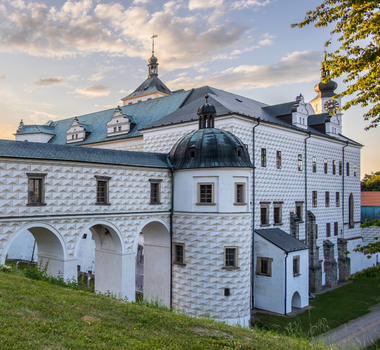
Pardubice Castle is one of the city’s most important landmarks. Originally built as a water fortress, it gradually developed into a Renaissance residence associated with the powerful Pernštejn family.
Today, visitors can admire the impressive Knight’s Halls, the Chapel of the Three Kings, and the remarkable wall painting Fortuna Volubilis (The Fickle Fortune), considered the oldest painted nude in the Czech lands.The castle complex also includes a Civil Defence Shelter, recalling the period of the Cold War. The East Bohemian Museum, located within the castle, presents a variety of exhibitions.
Visitors can also enjoy views from the castle ramparts and tower, while the courtyard café offers a pleasant place to relax.
For opening hours and current information, please visit the castle’s official website.
Pernštýnské Square
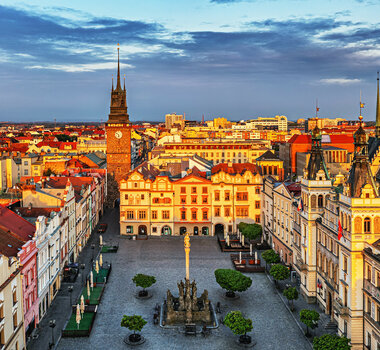
Pernštýnské Square forms the heart of Pardubice’s historic centre and has been part of the city’s conservation area since 1964. Around the square stand thirty historic townhouses representing several architectural periods, from late Gothic and Renaissance to Baroque and Classicism.
Today the square is also a lively cultural centre. It is home to the city hall, the House at Jonah – a branch of Gočár Gallery – as well as a library, cafés and restaurants. Throughout the year, the square hosts festivals, Christmas markets and other traditional events.
City Hall
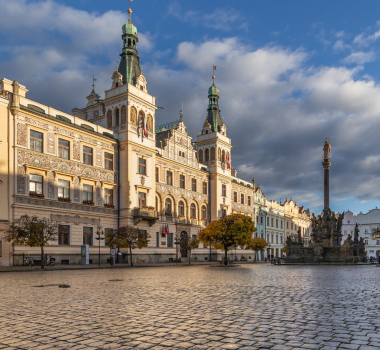
The Pardubice City Hall was built between 1892 and 1894 and is one of the most distinctive buildings on Pernštýnské Square. The large Neo-Renaissance complex on the northern side of the square was designed by architect Jan Wejrych.
Above the façade stands a statue of a knight, the symbolic guardian of the city, inspired by the figure of Vojtěch of Pernštejn. The façade is also decorated with medallions of Czech kings, including Charles IV, George of Poděbrady and Rudolf II.
Inside the building, visitors can find decorative frescoes by Karel Klusáček, representing four virtues associated with good city governance.
Automatic mills
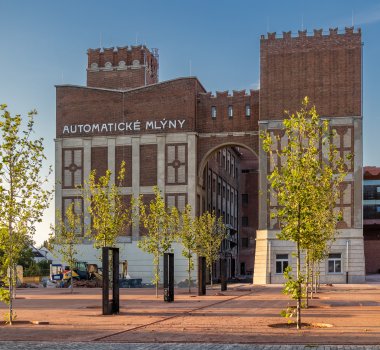
At the edge of the historic centre, just across the Chrudimka River, stands the striking building of the Automatic Mills, one of the most valuable examples of modern architecture in Pardubice. The complex was built in 1910 based on a design by architect Josef Gočár for the Winternitz brothers.
After more than a century of operation, the mills closed in 2013 and were later declared a National Cultural Monument. Since 2016, the former industrial site has been gradually transformed into a lively cultural and social district.
Today the complex houses Gočár Gallery, the GAMPA – Gallery of the City of Pardubice, the educational centre Sféra, and a branch of the Pardubice Tourist Information Centre. The area regularly hosts markets, concerts, theatre performances and family events.
Příhrádek
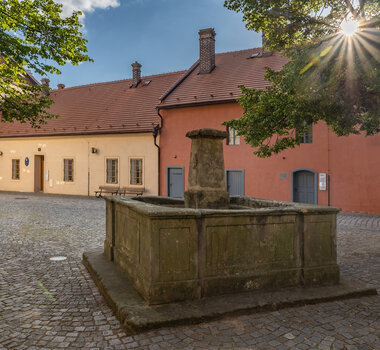
Příhrádek is a small triangular square connecting the historic centre with Pardubice Castle. Once part of the fortified entrance area, its two historic gates still recall its original defensive function.
Today, Příhrádek is one of the most charming corners of the city. Visitors will find an elegant Empire-style fountain, benches and a small book-sharing library. The square is also home to the U Vokolků Library Centre, where visitors can explore the Literary Museum.
Church of St. Bartholomew
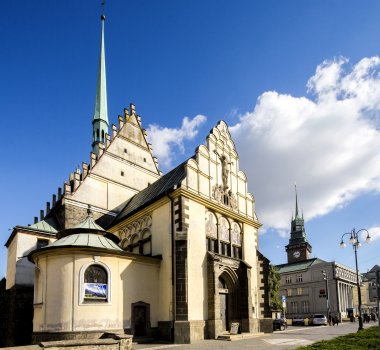
The Church of St. Bartholomew was built at the beginning of the 16th century. It served the Catholic minority of the city and also became the family burial place of the Czech branch of the Pernštejn family.
The presbytery features a large sandstone tomb with a marble monument to Vojtěch of Pernštejn. In 1912, a richly decorated extension was added to the western side of the church.
Its preserved layout and historical decoration make the church an important example of sacred architecture from the 16th century.
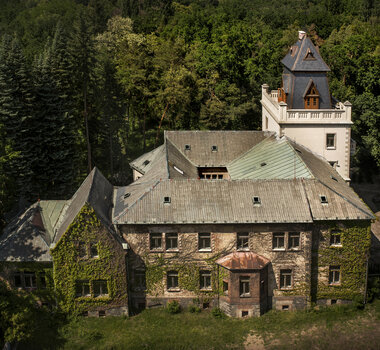
At present, this chateau is the property of the Czechoslovak Legionary Community and is enjoying intensive repair and care. It can be visited once a year during the European Heritage Days (mid-September), when guided tours take place.
Zámeček Memorial
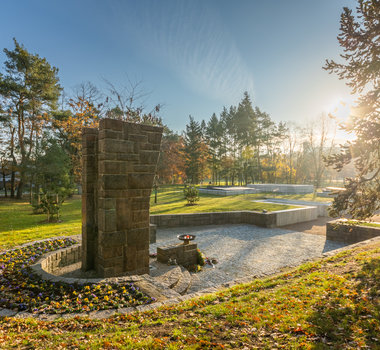
The Zámeček Memorial is one of the most important places of remembrance in Pardubice. During the Second World War, the Nazis established an execution site here operated by the Pardubice Gestapo.
After the assassination of Reinhard Heydrich in 1942, the site became a place of mass executions. Within just 18 days in June and July 1942, 194 people from the Pardubice, Kolín and Hradec Králové regions were executed here.
Today, the memorial consists of a commemorative outdoor area and a museum building with an exhibition dedicated to the events of the Second World War, local resistance and the stories connected with the paratrooper group Silver A.
Larisch Villa
Larisch Villa, also known as “Zámeček”, is a place with a powerful historical legacy. During the Second World War, it served as the headquarters of the German police regiment Schutzpolizei and was also used as a prison.
Some of the residents of the nearby village of Ležáky were held here before their execution in the nearby area of the Zámeček Memorial.
The villa was built in 1885 for Count Jiří Larisch-Mönnich based on a design by architect František Schmoranz. Today, the building is gradually being restored and occasionally opens to the public during special events such as Museum Night or European Heritage Days.
Crematorium
The Pardubice Crematorium is one of the most significant examples of Czech architecture from the early 20th century. The building was designed by architect Pavel Janák, with artistic decoration by painter František Kysela.
Completed after the First World War, the building is an example of the distinctive Czech architectural style known as Rondocubism. Its architectural concept was inspired by the layout of early Christian basilicas.
In 1968, the building and its surroundings were used as a filming location for the famous Czech film The Cremator directed by Juraj Herz.
Today, the crematorium is listed as a National Cultural Monument.
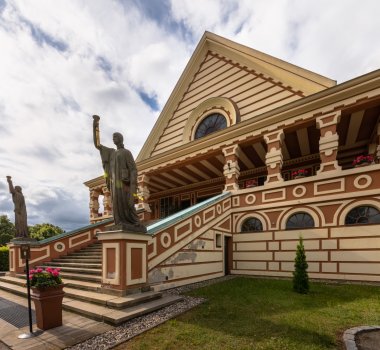
East Bohemian Theatre

The East Bohemian Theatre in Pardubice is one of the oldest permanent theatre stages in the Czech Republic. The foundation stone of the building was laid symbolically on the anniversary of the foundation of the National Theatre in Prague.
The Art Nouveau theatre was built between 1906 and 1909 according to the design of architect Antonín Balšánek. Above the façade rises a statue of a Genius with the face of the famous opera singer Ema Destinnová.
The theatre building remains one of the most distinctive landmarks of the city centre.
For the current programme and performances, please visit the theatre’s official website.
Kunětická hora Castle
Kunětická hora Castle is one of the most prominent landmarks of the Pardubice region and a popular destination for excursions. The first written mention of the castle dates back to 1420, when it was founded by Diviš Bořek of Miletínek. Its current appearance was largely shaped by the Pernštejn family at the turn of the 15th and 16th centuries.
Today the castle is a National Cultural Monument offering several guided tours and access to the tower, which provides wide views of the surrounding countryside. On clear days, visitors can see as far as the Krkonoše Mountains.
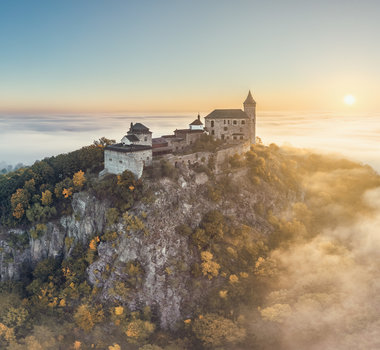
During the summer months, the castle hosts historical festivals, markets and theatre performances. Kunětická hora also appeared in the famous Czech television series Arabela, where it served as the residence of the wizard Rumburak.
A visit to the castle can also be combined with a walk through the nearby game reserve or a boat trip on the ship Arnošt of Pardubice.
For opening hours and current information, please visit the castle’s official website.