
Pilgrimage Church of St. John of Nepomuk in Žďár nad Sázavou
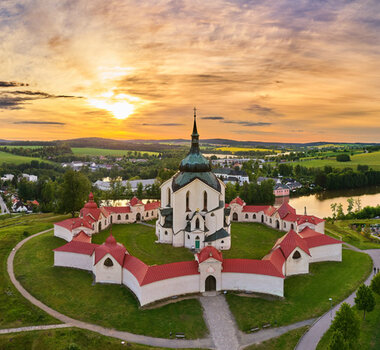
The Pilgrimage Church of St. John of Nepomuk, inscribed on the UNESCO World Heritage List in 1994, is one of the most unique architectural monuments in Europe. It was designed by the renowned architect Jan Blažej Santini and built between 1719 and 1722 in the distinctive style known as Baroque Gothic, which combines elements of Gothic and Baroque architecture.
The church is built on a ground plan in the shape of a five-pointed star. The number five appears throughout the design – in the layout, entrances, chapels and altars.
This symbolism refers to the legend of five stars that appeared above the water at the place where St. John of Nepomuk drowned.
The church stands on a hill called Zelená hora (Green Hill), near the former Cistercian monastery in Žďár nad Sázavou, and forms a striking landmark in the landscape.
Although the church was damaged by fire in 1784 and later temporarily closed, it was gradually restored and remains an important pilgrimage site to this day.
St. John of Nepomuk
St. John of Nepomuk was born around 1340 in Pomuk (today’s Nepomuk). He served as a vicar general of the Archbishop of Prague. During a conflict between the archbishop and King Wenceslas IV, he was arrested and tortured, and later thrown from Charles Bridge into the Vltava River.
His story soon gave rise to legends, and his cult spread across Europe. He was canonised in 1729 and became one of the most important Czech saints.
Source of photo: VisitCzechRepublic.cz